• HOME
  • ABOUT
    • CAREER
    • TESTIMONIALS
  • BLOG
    • Business
    • Creativity
    • Marketing
  • PODCAST
  • HOME
  • ABOUT
    • CAREER
    • TESTIMONIALS
  • BLOG
    • Business
    • Creativity
    • Marketing
  • PODCAST
BILLY LOIZOU

LEND ME YOUR EYES

Creating A WINNING STRATEGY FOR RETAIL

8/17/2021

0 Comments

 
ZERO TO LOYAL 💯

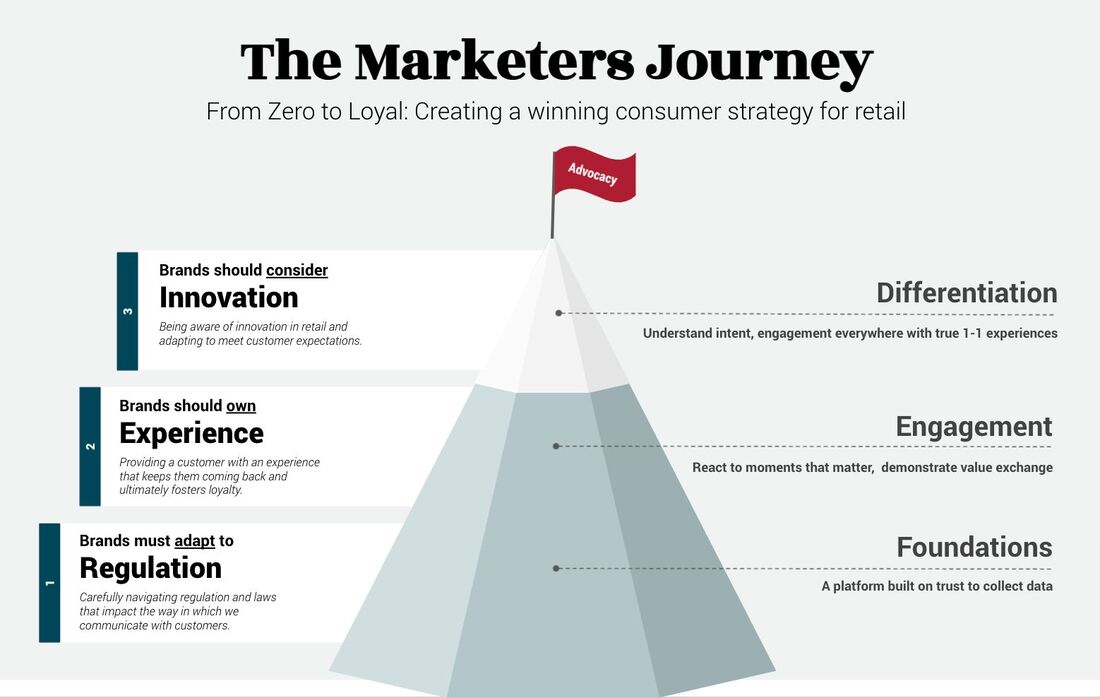
Recently, I started to think about some of the challenges that specifically retail marketers are facing. I couldn't help but illustrate what I believe, are the three key themes in the industry and how they are interrelated.

Let me explain by starting from the bottom of the pyramid:

1. Building direct-to-consumer relationships are king - The third-party phase-out has created a reason for brands to get closer to their customers. In order to build trust with today's customers, you need a data strategy that is built and governed around regulations and consent. A zero-party data strategy is important and once you have the data collection strategy you can work on planning the right engagement and experiences to connect across any point of sale.

2. Continue to demonstrate ongoing value - Today’s customer is flippant and has limited attention - so it’s your job as a brand to answer the big question “what have you done for me lately?” Well, now that you have data in place, foster a relationship built around the key lifecycle moments and provide content and offers which are relevant to the individual. You must however start with permission and access to the right 'ongoing' data created through the value exchange in point 1 above.

3. Embrace your brand and be confidently different - Creativity is becoming more important than ever; how can you elevate your brand to have distinct differentiation and utility - start by looking at your data and solve real consumer problems. No longer can you think about marketing channels in isolation and just rewarding customers on spend. A holistic approach will allow you to successfully navigate both the physical and digital mediums, this should be tightly integrated and allow you to predict and react to the customer whenever they raise their hand.
Picture
0 Comments

PERSONALISATION MATRIX

8/17/2021

0 Comments

 
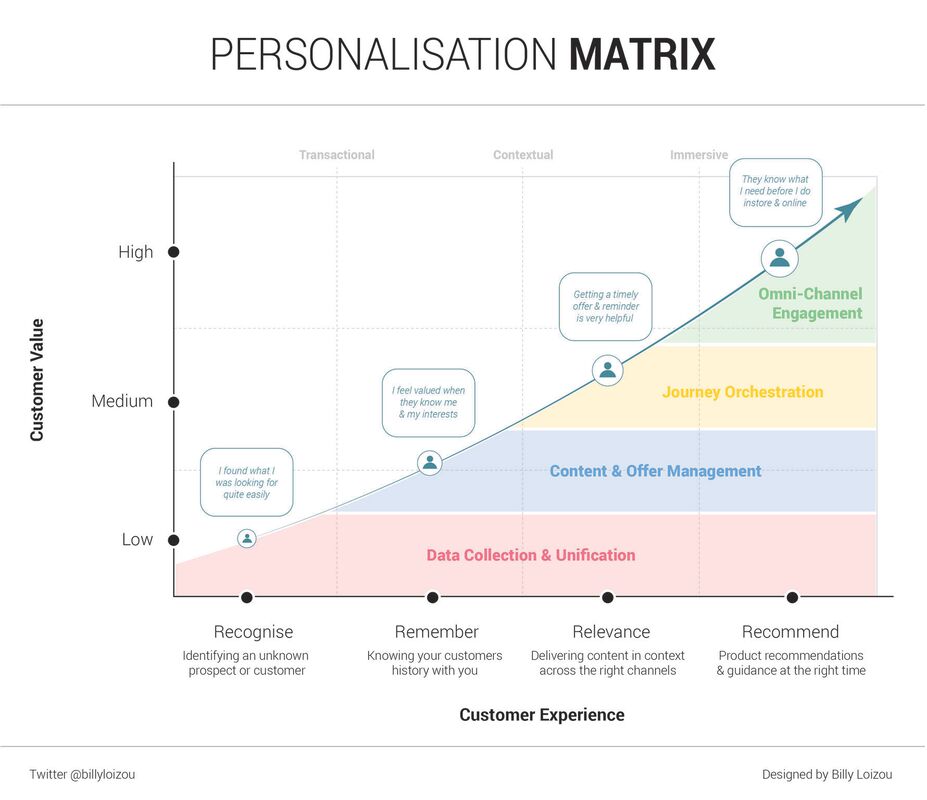
PersonAlisation is a buzz word that is thrown around in conversations without much thought of what it actually means.

The technology you need to drive true personalisation is only going to be as effective as the strategy you deploy and the data you collect to action. The power of true omni-channel personAlisation is still yet to be fully unlocked in most businesses.

Below is a diagram I have designed which should help illustrate Customer Value vs the Customer Experience using the 4R's of personalisation.
Picture
0 Comments

Is It Possible To Create A World Where YOU Own Your Data...And Get Paid?

3/25/2019

0 Comments

 
We live in a world today where data is king. Every business decision we make, marketing strategy we create, customer touchpoint we design is informed by or built to capture data.
​
Since working in marketing for over 10 years the holy grail for every organisation is to have a single customer view; a platform where they can store millions of different data points about their customers that can be viewed in one place. Marketers and I.T departments globally have invested billions of dollars in data lakes, data warehouses, DMPs, CDPs and the list goes on and on.

What if as an industry we got it all wrong?

I am loyal to around 4 brands; Apple, Nike, Brixton & Woolworths. I buy all my technology at Apple, shoes at Nike, hats at Brixton and groceries at Woolworths. Every single one of these businesses have a different perspective on Billy Loizou. Im sure all my demographic information is the same but there would be differences in almost every other data set. I don't mind receiving marketing material from these brands through email or social, BUT all of a sudden every Tom, Dick & Harry brand wants to use any of my 'so called' publicly available data through social platforms or via media agencies to target me. I get it, sometimes it's effective but I have never given you permission to message me, so now it has just become extremely annoying.

With GDPR soon to be mandated globally, Facebook getting dragged over the coals for their most recent behaviour with Cambridge Analytica and allowing anyone to be searchable with their security mobile number - TRUST is at an all time low with consumers and data SECURITY is at all time high with businesses.

What if we flipped the data value exchange model upside down?
​

Imagine a world where YOU the customer owned your data and had a single brand view; a platform where you can store all the different data points brands have about you in one place. You control and manage a simple profile of all your information and decide what data can be used for marketing and targeting purposes. Any change you make to your address, preferences, interests, subscription, updates every database you are apart of - or the brands that want to target you have to access this secure database which you control.

All of a sudden this model changes how business start paying for advertising, instead of paying media agencies and social giants to target "customers who may be interested in blah blah blah" - they pay you the REAL customer. Not only do you have complete control of your data but you also can get paid to be advertised to. I personally think a world like this is achievable.

Im a dreamer, if you are too I would love to connect over a coffee and chat anything to do with marketing.
0 Comments

My Greatest Achievement

12/25/2018

0 Comments

 
I remember the day vividly, I had attended my first business conference and the keynote speaker of the day spent almost 45 minutes talking about purpose. Very similar to Simon Sinek he reiterated time and time again, “why is that you do what you do?” To be honest it caught me by surprise because I had never really thought about it. The path I had taken up until this point was one that was manufactured for me; go to school, get good grades, finish year 12, select a course at university which you find the most appealing with the score your received, finish the course and find a job. At no point in time did I get asked “why”, so when this conference was over I was left utterly confused. From that day forward I was set on a wild goose chase to find my why.
​
I am lucky enough to have worked in some amazing business’s such as tech giant Salesforce & creative powerhouse TBWA. My career has had some extremely memorable moments, I have designed award winning work and made life-long friends, however I always had this glowing neon question mark hovering over my head.

The answer appeared on the 25th of May 2017 when my son was born. I realised that I had been living life by the wrong set of values, you can say I had an epiphany. I got so much enjoyment by the small things in life again; a smile, a cry, a laugh, a word, a clap….I didn’t get much enjoyment from changing nappies but it was part of the package. I realised that not everything I did day-to-day had to revolve around trying to change the world, it can start by just improving one persons world at a time. I realised through the journey of being a father the happiness and completeness comes from being selfless. I also realised that instead of trying to mask my creativity I should embrace it, bring 100% of me to the workforce everyday.

Since the age of 18 I have been writing and producing music however never shared it with many people. A few months after my son was born I decided to write a story for him called Baby On The Moon. The story was about a little boy who sets off on a space adventure to the moon with his best friend, a little black dog. The story ended up turning into a song and I am actually really proud of the end result, watch below.
​

​My greatest achievement in life is undoubtably becoming a father. It has helped me in every facet of my life, including my career by realigning my values and belief system to rediscovering my creative confidence. To all the other hard working dad’s out there who are balancing a demanding job and have a family at home, hats off to you. It’s not an easy gig and someday’s it’s extremely hard walking out the front door, especially when your little one is crawling behind you screaming “dada.” There is a silver lining though, having children gives you the confidence to step outside your comfort zone and pushes you mentally and physically in ways that you never thought were possible.
0 Comments

Mega, Macro, Micro: How to Balance your Marketing Mix

12/18/2018

0 Comments

 
Picture
It’s now been over 130 years since retail magnate John Wanamaker said “It’s the most famous problem in marketing. I know only half of my advertising works. The problem is, I don’t know which half.”

The ingredient list for today's marketing mix just keeps getting longer. The question every marketer asks themselves is how do I balance and prioritize my efforts between short-term sales activity and long-term brand building?

The Triple Threat Model
​
In basketball, the most effective player on the court is the one who can impact the game in multiple ways and not just by scoring. The player is coined a “Triple Threat,” as they excel in all three key skills — passing, rebounding, and scoring.
​
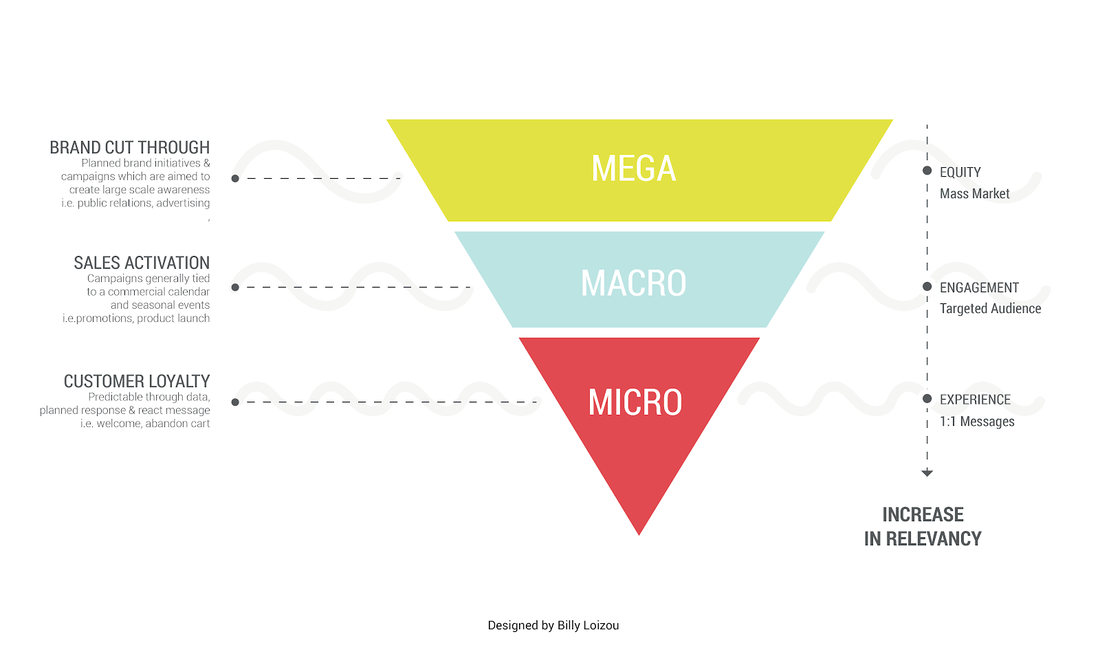
How does this relate to marketing, you might ask? Well, based on my experience in marketing within agencies, technology vendors, and brands — plus supported by research performed by the “Godfathers of Advertising,” Les Binet and Peter Field — I’ve identified three key moments that marketers should master. I crafted a model which aligns the mega, macro, and micro of marketing campaigns to enable short-term results and long-term brand building.
Picture
Mega Marketing — Creating Brand Cut-Through
Audience: Mass Market
Medium: Broadcast, Print Media, and Out-Of-Home
​
A successful mega-marketing campaign drives brand awareness, sparks conversation, and ultimately, fosters loyalty. Most big brands launch a campaign like this yearly and, based on the research from Binet and Field, emotional brand building is the key to long-term profits.
Picture
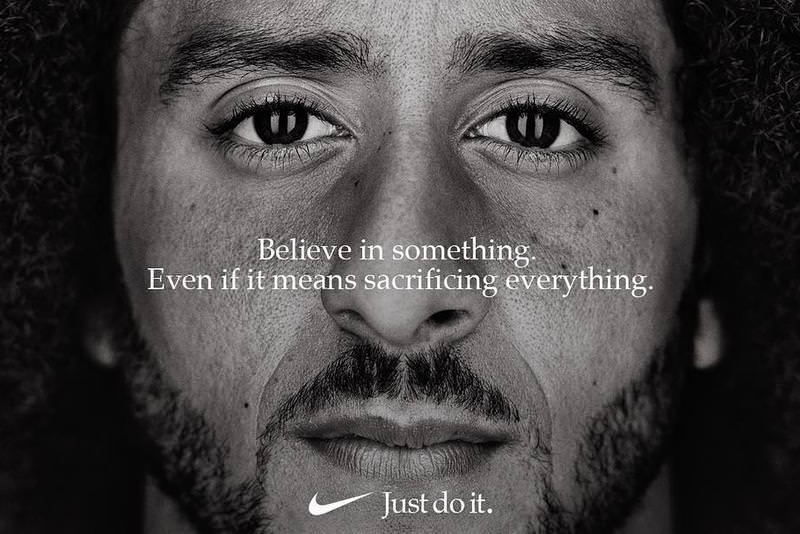
Nike turned heads with their most recent 30-year celebration of the “Just Do It” slogan. They showed their brand mentality and they got people talking about them by using Colin Kaepernick as the face of the campaign, the ousted and unfairly maligned NFL quarterback who made headlines for his protest during the national anthem by kneeling instead of standing.
Macro Marketing — Driving Sales Activation
Audience: Targeted Segments
Medium: Website, Display, Search, Social, Email & SMS
​
Effective macro-marketing campaigns target specific audiences, demand engagement, promote value and ultimately, drive sales. Most of these campaigns are tied to a commercial or seasonal calendar such as Christmas, tax time or holiday periods and excel with the use of rational-based messaging.
​
Picture
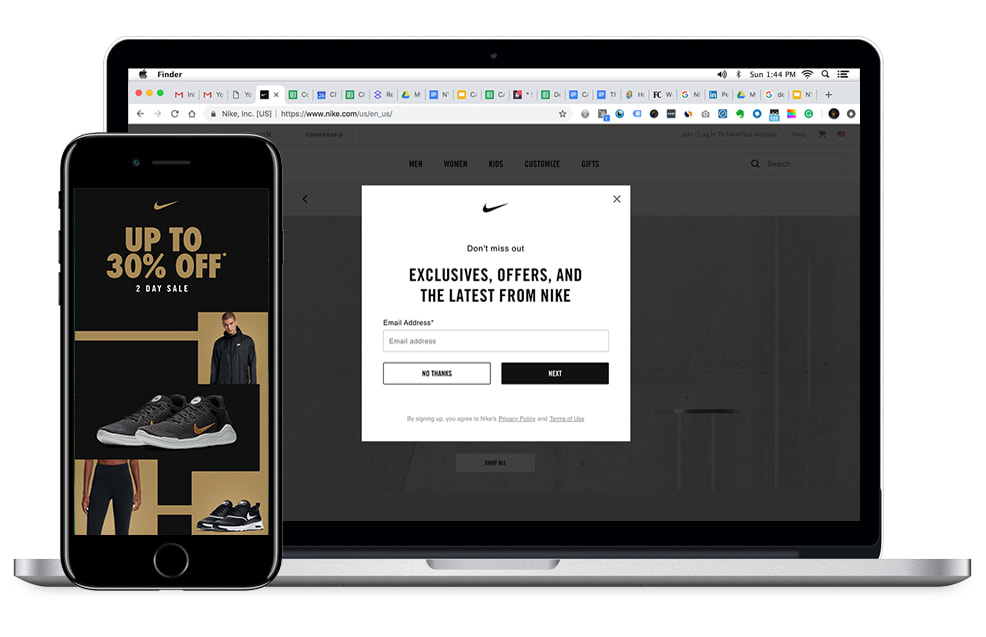
Nike is one of the few brands that doesn’t need to rely on discounts to drive sales. They provide their customers value by encouraging them to sign up to exclusive content, products, and offers via email. Throughout the different seasons, they introduce new looks and trends straight to the inbox and their customers anticipate each new release.
Micro Marketing — Earning Customer Loyalty
Audience: 1:1 Messaging
Medium: Email, SMS, Push, Direct Mail
​
Data-driven, micro-marketing campaigns typically are hyper-personalized and loyalty-focused, and ultimately, enable memorable experiences. Most of these campaigns are predictable in nature and are triggered based on a customer’s interaction with a brand.
Picture
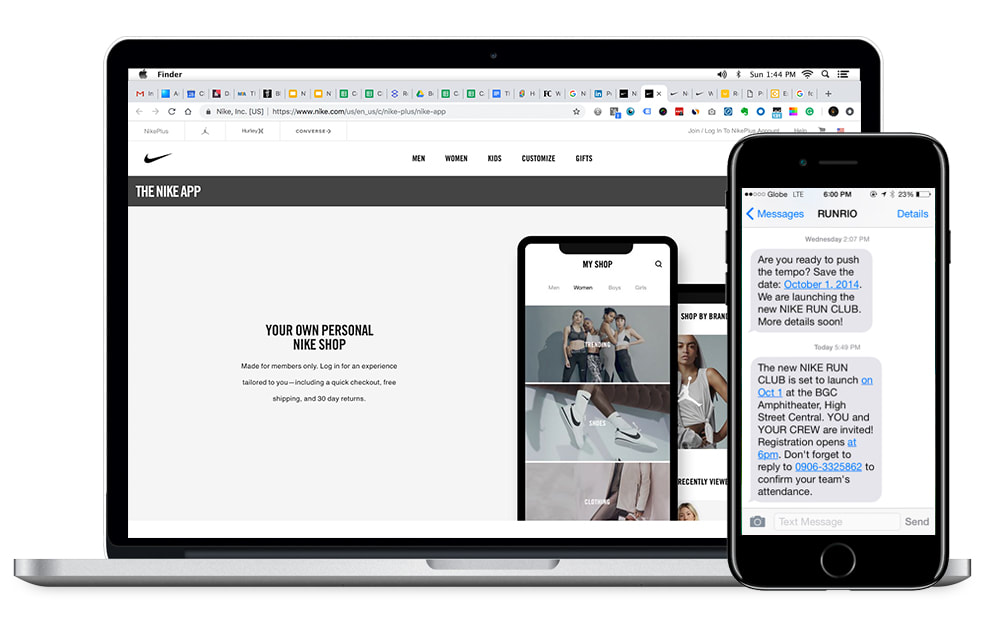
Nike+ is a beautifully designed rewards program for athletes. Customers are motivated by the ethos of authentic athletic performance. They have created a rewards program that is tailored to each member and delivers personalized product discounts that last your entire birthday month and exclusive VIP experiences. The more you shop and use the Nike+ app the more tailored it becomes.
What You Can Do Today To Impact Your Marketing Effectiveness
​
  1. Perform a gap analysis on your current marketing activity. The first thing you should do is plot your current Mega, Macro, and Micro moments so you can analyze where there are opportunities in your marketing strategy.
  2. Create balance in your marketing efforts. Marketers should use their advertising campaigns and budget split across brand building, sales activation, and creating customer loyalty. Marketing budgets are shrinking, so efficiency is key.
  3. Define what a loyal customer looks like and means to your business. Typically 55%-70% of a company's revenue comes from 15%-20% of their customers. The question is, are we treating these loyalty customers any differently? And if we could, what would we do to make them customers for life?
  4. Analyze your current customer experience. Identify where micro programs can improve the experience and drive significant ROI for your business by triggering a real-time email, SMS, or push notification. Typically, easy-to-implement programs such abandoned cart, post-purchase, or re-engagement can make an immediate impact on sales.
  5. Personalize your messages to improve customer engagement. Customers today don’t just want personalized communications, but products and services that are also tailored to them in real-time via the channels of their choice. How can you use the data you have today to improve content relevancy?
  6. Inject emotion into your brand-building messages. The most effective way to maximize customer value and long-term profits is to connect with customers at an emotional level.
  7. Stop discounting. Customers become accustomed to frequent discounting, resulting in a shift in focus from the value your brand provides. Frequent discounts are dangerous and erode long-term profits.
  8. Promote share of voice. Listen to your customers, anticipate their needs, and design offline and online experiences which empower them to promote your brand.
  9. Don’t be afraid to be creative. Capture your audience's interest, influence their response and inspire them to take action. This can be exceptionally powerful when combined with gamification or loyalty programs. Creativity can make your money go further.
  10. Test different marketing channels. Too often I read articles about the death of email or the end of print, it’s time to put those conversations to bed and test what works with your customers. Typically a mix of channels and messaging provides the best results for businesses today.
0 Comments

Rise Of The Intelligence Economy

1/8/2017

0 Comments

 
Picture
2015 was the year of the Customer Journey, 2016 was the year of Design Thinking....so what's does 2017 have in store for businesses and marketers across the globe?

To find an answer I decided to do some research on how the economy has changed over the last 50 years. It was evident that consumers are willing to pay a premium for a product or service based on it's perceived value; such as does it save me time? does it create a memorable experience? does it have long lasting qualities?

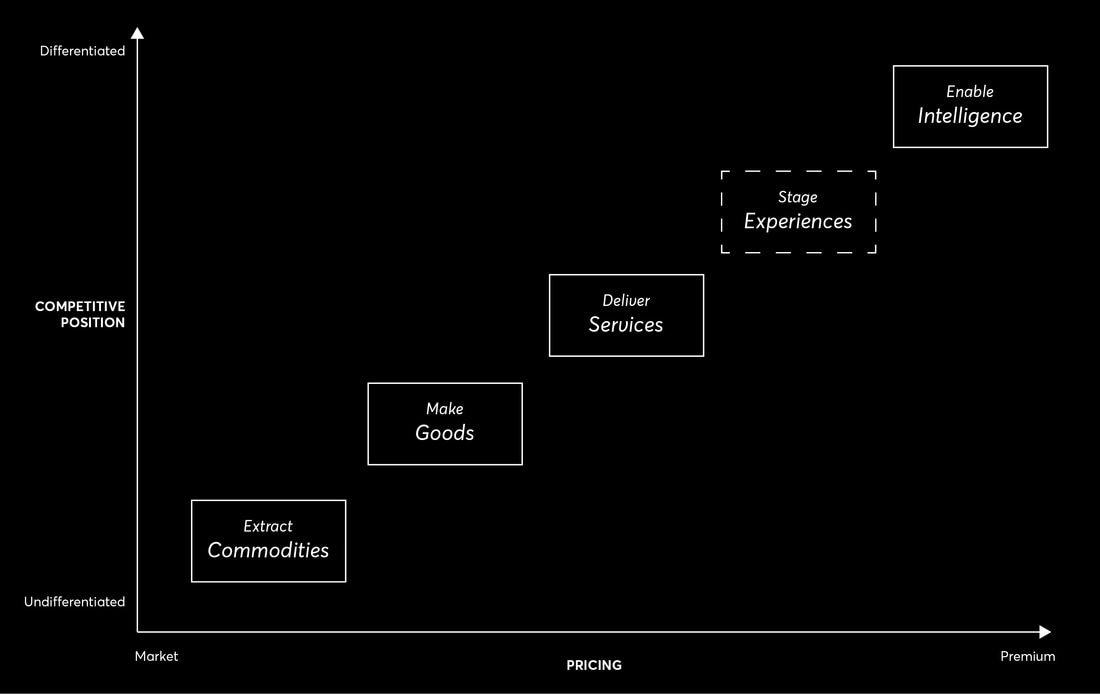
Thanks to Joseph Pine II and James H Gilmore they made it quite simple to understand with an article on HBR called 'Welcome To The Experience Economy.' They simplify the entire history of economic progress across the four stages of evolution using a birthday cake as the example:


  1. The Commodities Economy: As the agrarian economy advanced, mothers made birthday cakes from scratch, mixing farm commodities such as flour, sugar, butter and eggs. That together it would cost a dollar - however it took time to buy the ingredients and make the cake.

  2. The Goods Economy: As the goods-based industrial economy boomed, mothers paid a few dollars to Betty Crocker for premixed ingredients, where all you had to do was follow the recipe and bake the cake - you saved time and ingredients by buying it all in one box.

  3. The Services Economy: When the service economy took hold, busy parents ordered quality made cakes from the bakery or grocery store. It would cost $10-$15, far more then packaged ingredients however it was convenient, desirable and saved you time in the kitchen.

  4. The Experiences Economy: In the time starved late 90's, parents neither make the birthday cake nor even throw the party. Instead, they spend $100 or more to outsource the entire birthday event to Mc'Donald's so they can stage a memorable event for the kids - and the cake is thrown in for free.

An experience occurs when a company intentionally uses services as the stage, and goods as props, to engage individual customers in a way that creates memorable events. Experiences have always been at the heart of the entertainment business - think Walt Disney. However if you could charge admission for consumers to interact and engage with your brand, what would you do differently? - thats a good place to start brainstorming.
Today the concept of selling experiences is spreading beyond theatres and theme parks
​Customer experience today has become one of the key pillars for organisations around the world - irrelevant of industry. Consumers desire experiences, whether it be buying a laptop at the Apple store, staying at the Hilton for a few nights on a business trip or going into an ANZ bank branch to take out a mortgage on a new home.

​The Digital Evolution = The Intelligence Economy

Picture
Over the last 10 years we have seen amazing advancements in digital technology - from cloud computing, mobile smartphones, virtual & augmented reality and now the explosion of machine learning. This has made a significant change to customer behaviour as now not only do we expect a personlised service from all brands but it has created a need for us to have access to that information and knowledge on demand.

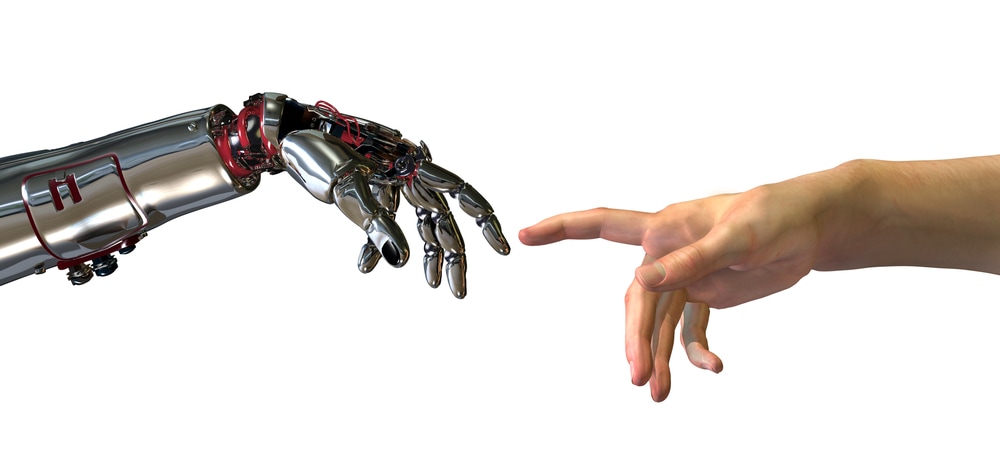
Good businesses today meet customer expectations through seamless, invisible service that predicts their needs and wants. Welcome to the intelligence economy where experiences are driven by customer data, underpinned by artificial intelligence and personalised to the individual through the channel of their choice. Let's simplify it by bringing it back to the birthday cake.

The Intelligence Economy: In the digital evolution during the internet boom, parent's want to be able to order the cake or book the event while on the go from their mobile phone, they would also like personalised recommendations based on there searches, inspiration from social sources and access to the information (recipes) and tools (applications) so they can recreate the experience themselves if needed. Delivery to the front door will be included in the cost of the cake.
​
The businesses that utilise their data and serve it in meaningful powerful ways to help there customers will charge ahead in 2017. Creating intelligent and smart tools that allow consumers from their homes to have meaningful interactions with your brand are the next battleground.
​
How about a bank that provides you the tools to scenario plan and budget for your future using your real-life data, such as transactional history i.e where am I spending my money? what investments can I make? How about a gym that tracks your activities on the treadmill, then through a Fit-bit to provide tailored food plans to help you reach your desired weight? How about a real-estate agency that guides you through a lifestyle application online and then can recommend a suburb for you to live in based on it's demographic profile? The list of possibilities goes on when you combine data, technology and creativity...
2017 is the year of Artificial Intelligence
The goal is to turn data into information, information into insight and insight into actions
We are going to see some amazing advancements in this space - IBM Watson and Salesforce Einstein are just the beginning. If you are interested in this space pick up a book called "The Master Algorithm" by Pedro Domingos.
0 Comments

Blockbuster VS. NETFLIX

3/22/2016

0 Comments

 
Picture
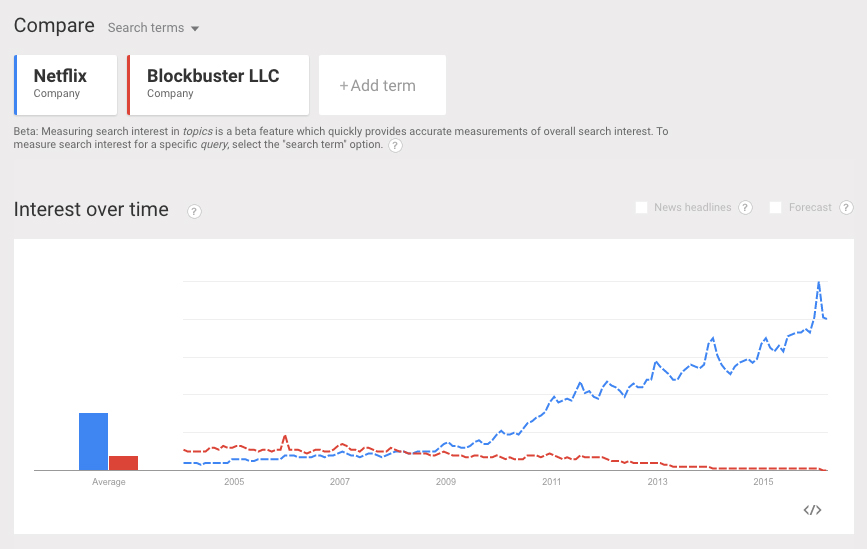
Blockbuster in 2004 ended negotiations in buying 49% share of Netflix for $50 million. One of these businesses is now bankrupt...the other one has a market valuation of over $30 billion. Companies need to not lose sight of the bottom line, however innovation and a change in customer behaviour can have you scratching your head only ten years later. 

Former Blockbuster workers all over the world must cringe every time they hear the words “online streaming” and “on-demand.”


That’s because back in 2000, Reed Hastings approached former Blockbuster CEO John Antioco and asked for $US50 million to give away the company he founded — Netflix.

Antioco, thinking that it was a “very small niche business,” ended the negotiations and didn’t buy Netflix, which at the time was a DVD mailing service, according to Variety.

Now Netflix — just short of being worth the same as CBS last year — soared past the television network owner with a $US32.9 billion market valuation. Netflix also reached the 50 million mark in subscribers of its paid service and became available in 40 countries, CNN Money reported last year.

“Management and vision are two separate things. [Netflix was] losing money,” a former Blockbuster exec told Variety back in 2013, explaining Antioco’s decision.
This isn’t the first time that a company missed out on an opportunity that could have shifted continents of the business world. There have been other bitter “what ifs” including: Verizon shunning Apple for the first model of the iPhone, Comcast foregoing Disney, Friendster refusing Google, and AOL merging with Time Warner instead of AT&T.

Perhaps the company that made the biggest blunder in tech history is Yahoo, which had chances to buy both Google and Facebook.

Source: 
http://www.businessinsider.com.au/
0 Comments

2016 Digital Trends (Part 1 of 2)

2/26/2016

0 Comments

 
Picture
"If I had asked the people what they wanted, they would have said a faster horse - Henry Ford"
Henry Ford in the late 1800’s was a pioneer in the automobile industry. Consider this: By the end of 2017 driverless cars will no longer just be an idea, they could very likely become reality. How does that change our lives and how much more potential time does that unlock between our day-to-day activities. These big ideas and innovations are why I go to work everyday - growth, sustainability, evolution and pushing the boundaries of customer experience.

Creativity is thinking up new things, innovation is doing new things. To simplify, businesses today have two key areas they need to accelerate in, and that's marketing and innovation. Innovation is change that unlocks new value and marketing is demonstrating and selling that value. Amidst the rapid pace of innovation, changing consumer expectations, and the plummeting cost of advanced technology, there is immense opportunity for organisations, governments and society.

Digital is disrupting traditional business models and changing consumer behaviours. The mobile phone is no longer a device to make a phone call, it is an omni-channel computer in our pockets that allows us to control our finances, track our health, make purchases and communicate with the world. Here’s a closer look at the first 5 digital trends expected to influence the next generation of experiences:

1. Virtual Reality 
Virtual Reality will become mainstream and debut in 2016 with the first consumer versions of Sony, Oculus, and the HTC Vive hitting the market. Companies and designers will now start thinking about how they can go beyond the gaming experience and bring VR into everyday lives for things like tourism or watching live sports. For example it’s the 2016 AFL Grand Final and you can buy a virtual ticket, sit amongst the cheer squad behind the goals, hear the crowd roar and at any stage - change your perspective and angle.

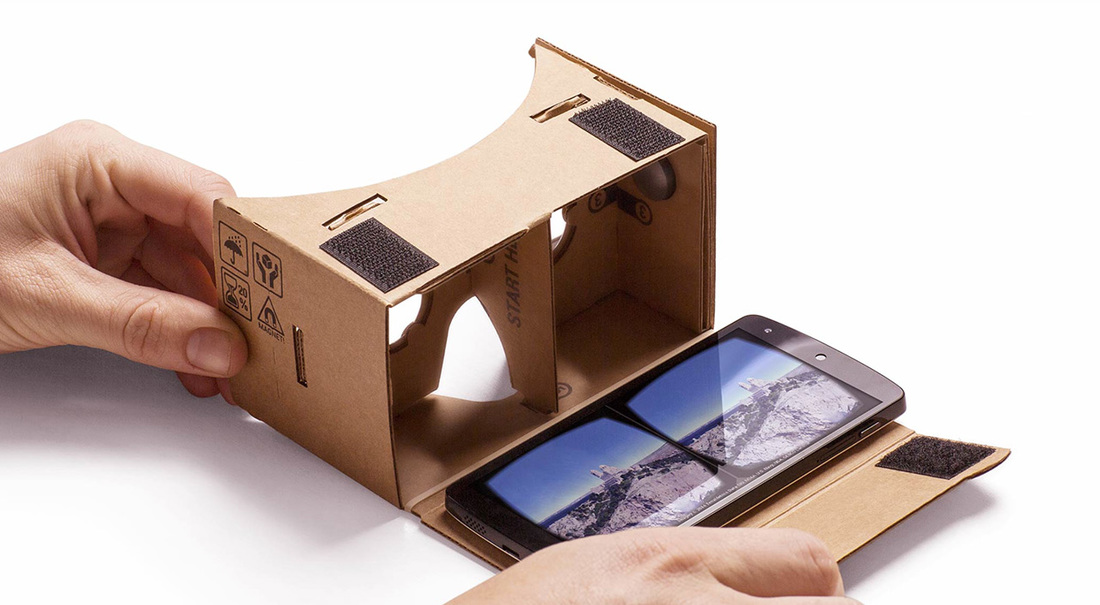
Google have created a great cheap alternative to educate and get consumers familiar with Virtual Reality, they call it Google Cardboard. For $20 you can buy a cardboard headset and use your smartphone as the screen. See the example below:
Picture
Here is a great example on how Virtual Reality will change the real-estate world: http://www.billyloizou.com/thoughts/how-virtual-reality-will-change-the-world-we-live-in

​
2. Augmented Reality

Augmented Reality is the integration of digital information with the user's environment in real time. Unlike virtual reality, which creates a totally artificial environment, augmented reality uses the existing environment and overlays new information on top of it. 
​
Some amazing apps have been released which can enhance your experience and give an almost real life perspective. Companies like IKEA, L’Oreal and Glasses.com allow you to interact with their products without having to visit their physical store. For example, L’Oreal have released an app that allows you to try on make up from the comfort of your own home. The app is called ‘Make Up Genius’ and the concept and execution is remarkable.

The investment in this line of work is becoming larger every year and industry leaders Magic Leap have just raised $793.5 million dollars in funding from the Alibaba Group. Their mission is creating a new world where digital and physical realities seamlessly blend together to enable amazing new experiences. Here is an example of some their work:
​

3. Virtual Assistant. Help me.
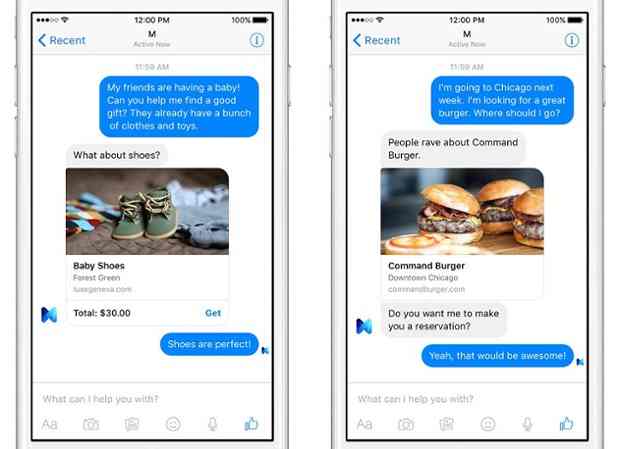
Not everyone is fortunate enough to have assistants that can take care of some of their day-to-day tasks. In today’s fast paced world, increasing productivity is up there as one of the top 5 requirements for most CEO’s. Welcome Facebook M, a personal digital assistant inside of Messenger that completes tasks and finds information on your behalf. It’s powered by artificial intelligence that’s trained and supervised by actual people. Thanks to Facebook, everyday people will be able to get simple tasks done for them like making a restaurant reservation, ordering takeaway, buying flowers for loved ones, finding local dog friendly beaches and much more.

One of M’s most popular requests from its Facebook employee testers, was that the service can call your telco company and endure the endless hold times and automated messages to help you set up home wifi or cancel your Foxtel. The main differentiator between Facebook M and Siri is that their is an actual person on hold for you called a Facebook M trainer. 
Facebook’s M trainers have customer service backgrounds. They make the trickier judgment calls, and perform other tasks that software can’t. If you ask M to plan a birthday dinner for your friend, the software might book the Uber and the restaurant, but a person might surprise your friend at the end of the night by sending over birthday cupcakes from her favourite bakery. Over time Facebook will use complex AI with their history of data to predict these outcomes to reduce the burden on their trainers.
​
Picture
​
4. Voice Activation. Listen to me.
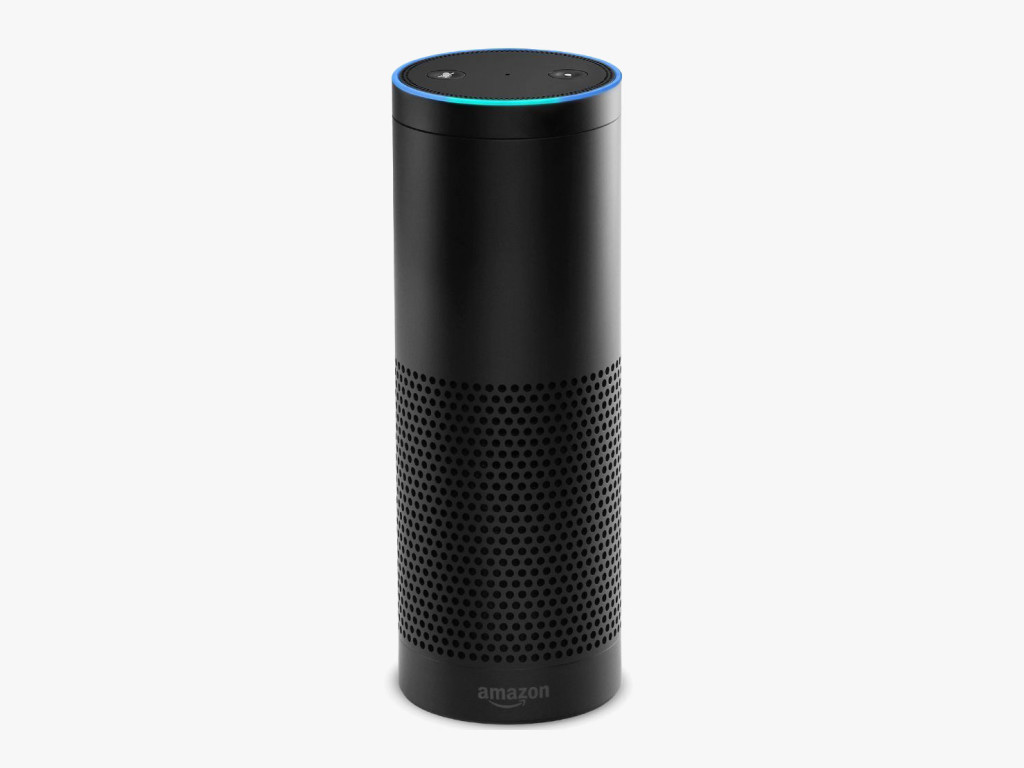
In the latest release of Wi-Fi gadgets, Amazon have launched a speaker that listens. The Amazon Echo is a cylindrical bluetooth speaker that listens when you talk to it. For those who enjoy making noise or bossing around inanimate objects then this a great device for you.


The most obvious use case for Echo is to play music or podcasts. However the future use would be to connect it to your other smart devices. Right now Echo works with SmartThings, Insteon, WeMo, Hue and Wink devices, which covers most of your bases. Commands are mostly limited to turning things on or off, or brightening or dimming lights. These might be basic triggers but the future is quite exciting if all you have to do is yell out from bed for a coffee or to turn on the air-conditioning.
Picture

5. Machine Learning
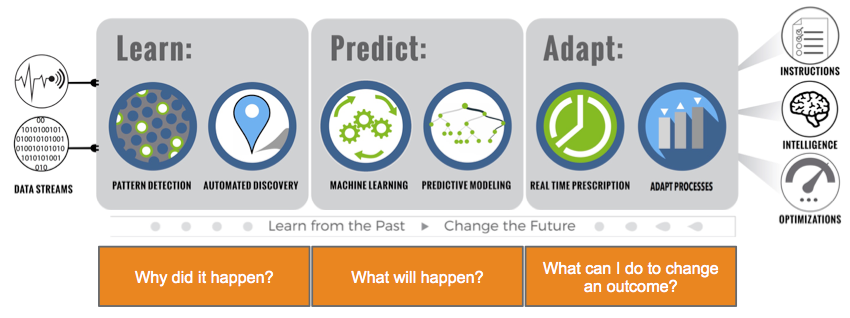
Machine learning is a type of artificial intelligence that provides computers with the ability to learn without being explicitly programmed. Machine learning focuses on the development of computer programs that can teach themselves to grow and change when exposed to new data. The process of machine learning is similar to that of data mining. Both systems search through data to look for patterns. 


Marketers can leverage this technology in multiple ways when creating customer journeys. The journeys themselves will adapt, restructure and remodel themselves to become more successful overtime by understanding the moments when customers are most likely to engage. Machine learning will allow you to optimise in real-time based on the history of data available. Companies like Salesforce are leading the race by acquiring PredicitionIO, a start up based out of Palo Alto that have developed an open source-based machine learning server.
Picture
2016 Digital Trends part two will be available shortly. Subscribe to stay tuned!
0 Comments

FINDING THE MOMENTS THAT MATTER

2/2/2016

0 Comments

 
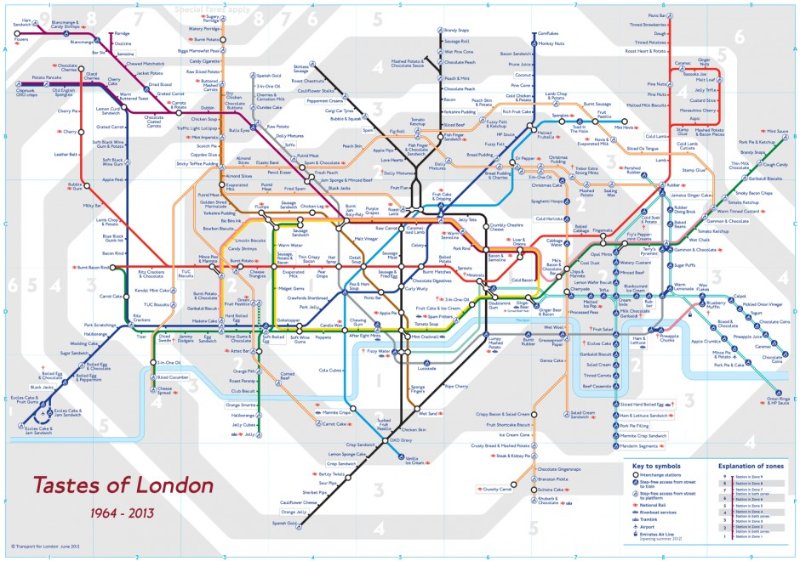
Harry Beck, a young draughtsman who drew electrical circuits for the Underground pioneered the way we visualise information today. You wont find his face on any coins or stamps, but his fingerprints are all around London. He is responsible for the most influential transit map created for the London tube, which has spawned similar designs across the globe.
​
Picture
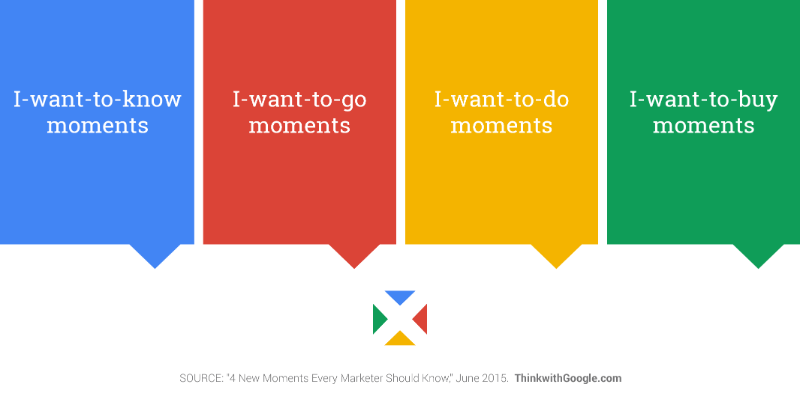
Prior to Beck's design on the underground train map it was about as eligible as a dropped pizza. His designs have helped passengers get a better understanding of where they want to go, at a time that is extremely confusing for those new to transport or in a foreign country.  To the passenger this was in essence a "I-want-to-go moment" and has become critical to their experience.

Here are some other key customer moments: ​
Picture
Check out Googles Micro Moments project for more on this, each one is a critical opportunity for brands to shape their customers decisions and preferences.

According to Google our mobile has forever changed the way we live, and it’s forever changed what we expect of brands. It’s fractured the consumer journey into hundreds of real-time, intent-driven micro-moments.

What Can You Do Today:
  1. Make a moments map: Identify a set of moments you want to win or can't afford to lose. Examine all phases of the consumer journey to map moments when people want to find inspiration, learn about your products, make a quick purchase, or anything in between.
  2. Understand what the customer needs in the moment: For each moment you want to win, put yourself in the consumer's shoes. Ask “What would make this easier or faster? What content or features would be most helpful for this moment?"
  3. Use context to deliver the right experience: Leverage contextual signals like location and time of day to deliver experiences and messages that feel tailor-made for the moment. For example, let customers searching nearby your stores know when the products they’re looking for are in-stock or available for pickup in-store.
  4. Optimise across the journey: People move seamlessly across screens and channels. Does your brand deliver seamlessly in return? Don’t let competing objectives or department silos stand in the way. To account for today’s complex, fractured journeys, anchor completely on the consumer and organize around moments.
  5. Measure every moment that matters: You cannot afford to under-serve your customers while you're dealing with measurement gaps. While the return on investment for certain moments may not yet be directly measurable, train your team to use credible estimates to ensure nothing’s falling through the cracks.

I recommend all marketers sign up to the 'Think with Google' newsletter:
https://www.thinkwithgoogle.com/

Download the micro-moment case study
0 Comments

The Customer Service Revolution #CustomerClienteling

1/31/2016

0 Comments

 
Picture
Shopping is now a 24/7 experience. Digitally savvy customers are able to research, compare products and prices, and read reviews before making a purchase decision. They are becoming more vocal and share their brand experiences—good or bad—with their social network. Most brands struggle today to deliver a positive experience from sale through service and 89% of customers are leaving brands due to a bad customer experience.
​
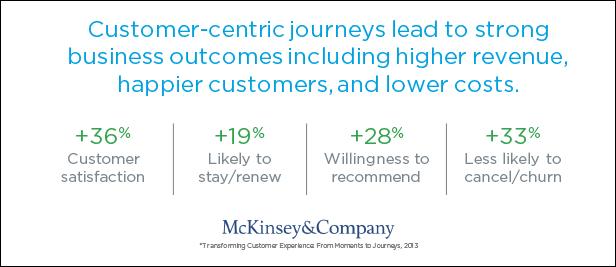
It is no surprise that companies who invest in a 'customer-centric' strategy are seeing amazing results in their overall business KPI's. The best brands in the world provide their customers with a memorable experience...that experience creates an emotional connection which will stay with the customer for life. McKinsey & Company provided some research in 2013 to support this theory.
Picture
​Fast forward towards the end of 2015 and these statistics above are even more convincing. Organisations are no longer just focused on the 'Increase in ROI' they are now also conscious of two other metrics; 'Customer Satisfaction' and the 'Willingness to Recommend.' The close link between service and marketing is now apparent. A well armed marketing team should help set up every department around them to know the customer more intimately. The key is then being able to serve the customer information in a friendly and actionable manner. Welcome customer clienteling.
Picture

​Customer Clienteling: Serve Your Customers Better!

Retailers today need to empower their employees with information that allows them to have a helpful and meaningful conversation with clients. Innovators are recognising that the retail industry needs tools that truly fit the way consumers shop and how sales people sell. Retailers and consumers have embraced these reimagined tools, and these companies are seeing great success. According to PWC the following clienteling tools enable:
  1. Connected Customers: Armed with a dynamic customer profile, sales and service associates can now make informed, personalised cross-sell and up-sell recommendations to customers at the point of sale. The payoff? Higher sales per customer and improved customer loyalty.
  2. Connected Stores: The solution helps retailers create seamless, consistent interactions and experiences across multiple channels—including online, in-store, on mobile devices and via social media. The result is improved customer satisfaction and loyalty.
  3. Connected Employees: Better-connected employees—those who collaborate more effectively, share success stories, and contribute first-hand product knowledge—help improve their own performance as well as that of their peers. For the enterprise, this means greater operational effectiveness.
  4. Connected Products: The solution can help deliver real-time insight into customer preferences, buying habits, product reviews and product availability. Armed with that data, enterprises can make better, informed decisions, scale more easily and increase their returns on investment. 

Customer Journeys: Bring together the physical & the digital
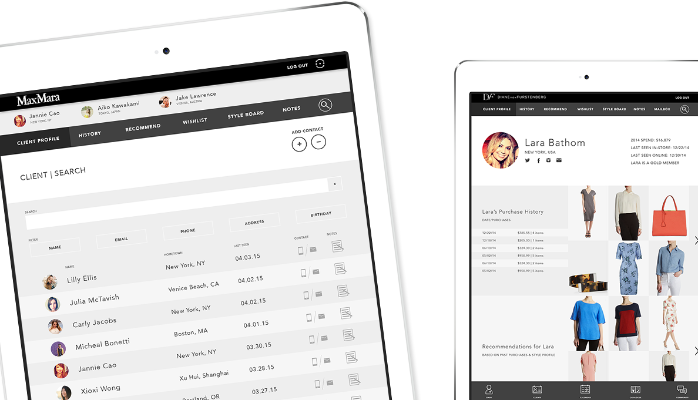
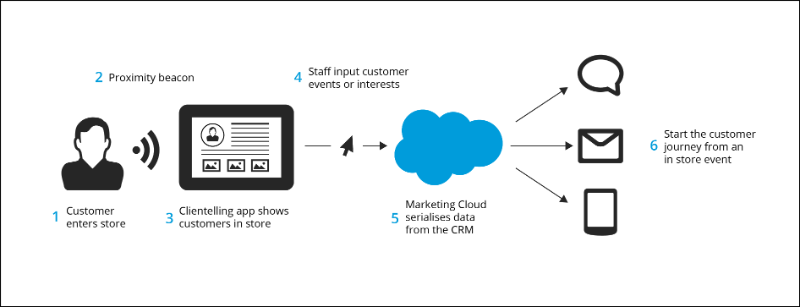
Customer clienteling has been around for a few years now, particularly in the retail and financial space. However utilising the Salesforce platform, customer clienteling solutions can now trigger real-time journeys straight from the Marketing Cloud whilst the customer is in store or just left. 

Imagine you are an existing customer and visiting a Country Road store. You are browsing their summer range when you get approached by Samantha one of their friendly customer service staff. Samantha has an iPad in her hand and with the quick scan of your loyalty card or by utilising iBeacon technology can access your customer record. Samantha now has access to your:
  1. Customer Profile Information
  2. Style Recommendations
  3. Wish List Items
  4. Online Browsing Behaviour
  5. Purchase History Details
  6. Loyalty Status and Special Offers
Some customers might be frightened by companies having access to this amount of data but the objective is purely to provide a more personalised shopping experience. Samantha now becomes your own personal stylist and the same unique experience you get online can now also happen in store. Samantha also now has the ability to send you communications from within the store during your shop. For example items you have recently tried on, items that customers similar to you have purchased, trending items online, the products you have put on lay-by or more importantly send a personalised message from Samantha herself after the shop. The insights can power Samantha's conversation and level of service, however provide the relevancy to enhance your shopping experience. See the example below:
Picture
The lines between the physical and the digital are slowing becoming blurred. We can now push the boundaries of CRM, digital marketing, and the in-store experiences. 

If you would like to hear more about these leading solutions, I recommend you reach out to the thought leaders and innovators in this space Proximity Insight: http://www.proximityinsight.com/.

You wont be disappointed!
"Customer service is not a department 
....it's everyone's job!"
0 Comments
<<Previous

    Archives

    September 2021
    August 2021
    September 2020
    August 2019
    April 2019
    March 2019
    December 2018
    June 2018
    March 2018
    January 2017
    August 2016
    June 2016
    April 2016
    March 2016
    February 2016
    January 2016

    Categories

    All
    Business
    Creativity
    Customer Journeys
    Design
    Digital Marketing
    Innovation
    Phygital
    Poem
    Service
    Video
    Virtual Reality

Let's Connect ON SOCIAL


​© 2016 Billy Loizou, all rights reserved
​