
|
I remember the day vividly, I had attended my first business conference and the keynote speaker of the day spent almost 45 minutes talking about purpose. Very similar to Simon Sinek he reiterated time and time again, “why is that you do what you do?” To be honest it caught me by surprise because I had never really thought about it. The path I had taken up until this point was one that was manufactured for me; go to school, get good grades, finish year 12, select a course at university which you find the most appealing with the score your received, finish the course and find a job. At no point in time did I get asked “why”, so when this conference was over I was left utterly confused. From that day forward I was set on a wild goose chase to find my why.
I am lucky enough to have worked in some amazing business’s such as tech giant Salesforce & creative powerhouse TBWA. My career has had some extremely memorable moments, I have designed award winning work and made life-long friends, however I always had this glowing neon question mark hovering over my head. The answer appeared on the 25th of May 2017 when my son was born. I realised that I had been living life by the wrong set of values, you can say I had an epiphany. I got so much enjoyment by the small things in life again; a smile, a cry, a laugh, a word, a clap….I didn’t get much enjoyment from changing nappies but it was part of the package. I realised that not everything I did day-to-day had to revolve around trying to change the world, it can start by just improving one persons world at a time. I realised through the journey of being a father the happiness and completeness comes from being selfless. I also realised that instead of trying to mask my creativity I should embrace it, bring 100% of me to the workforce everyday. Since the age of 18 I have been writing and producing music however never shared it with many people. A few months after my son was born I decided to write a story for him called Baby On The Moon. The story was about a little boy who sets off on a space adventure to the moon with his best friend, a little black dog. The story ended up turning into a song and I am actually really proud of the end result, watch below. My greatest achievement in life is undoubtably becoming a father. It has helped me in every facet of my life, including my career by realigning my values and belief system to rediscovering my creative confidence. To all the other hard working dad’s out there who are balancing a demanding job and have a family at home, hats off to you. It’s not an easy gig and someday’s it’s extremely hard walking out the front door, especially when your little one is crawling behind you screaming “dada.” There is a silver lining though, having children gives you the confidence to step outside your comfort zone and pushes you mentally and physically in ways that you never thought were possible.  After spending the last 10 years of my career working with marketers and leading customer experience with some of the world’s most trusted brands, I thought it was about time I grounded myself in my own research project – to speak with and learn from 50 marketers in just 50 days. To be honest it seemed like an achievable challenge – didn’t anticipate that organising 50 different marketers diaries was near impossible. I was successful however and the conversations were invaluable. I was lucky enough to meet with CMOs from all over Asia Pacific across retail and banking to not-for-profit. Importance of customer experience One thing that we all agreed on during the 50 days was how customer experience continues to become more important and is quickly becoming the new competitive battleground for brands. The investment today in global customer engagement is north of $3.6 billion dollars according to multiple marketing reports. Marketers understand the importance of technology and data to deliver great customers experiences, however most aren’t achieving the results they were promised or thought were possible. Decreasing budgets The fact that many marketers aren’t getting the return on their technology investment may have something to do with the fact that marketing budgets have decreased for the first time in four years according to Gartner’s latest Spend Survey. Marketing leaders must now justify their past spend and show the returns they deliver. It is clear that expectations in the boardroom are not being met and it’s time to show results that are actually delivering real business outcomes. 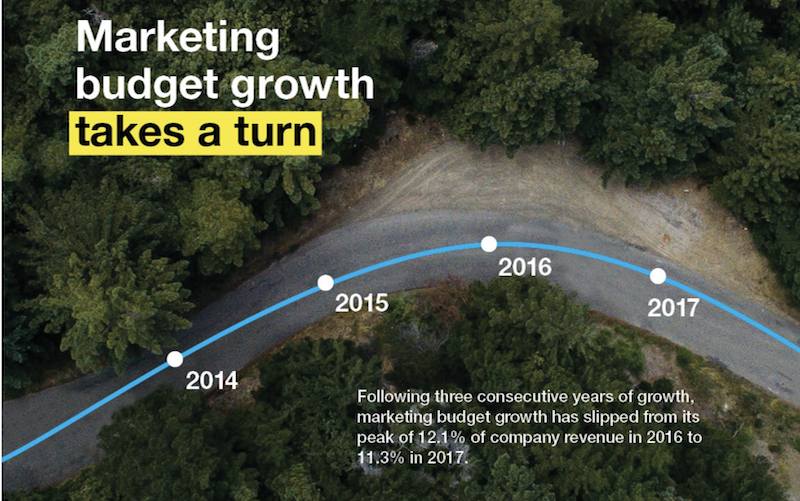 The biggest hit has been the investment in martech as it has fallen by 15%. CMOs are pulling back on last year’s high spending commitment amid concerns over marketing’s capability to acquire and manage technology effectively. The need today is far greater than it has ever been in re-evaluating your technology investment, reviewing the capabilities of your resources internally, and creating alignment across the whole business. Setting Priorities So what becomes extremely important as marketing budgets are shrinking? Combining the right marketing platform with the right people to execute your strategy successfully. Over time the obsession for marketers investing in shiny objects has led them to some cold hard truths. In the Mad Men era marketers invested heavily in agencies to think creatively about how they could advertise and communicate their brand to the masses. Many strategically sound concepts were presented. Fast-forward to today and marketers are investing heavily into marketing clouds and futuristic-sounding technology to advertise and communicate their brand at a 1-to-1 level. Technology is not a strategy. It is an enabler to help you implement and achieve your strategic vision. Mark Ritson, award winning columnist and marketing professor, said shiny objects such as virtual reality, augmented reality, artificial intelligence etc. are distracting us from our real jobs and the big challenges that we are all facing. He said, “The history of marketing is not filled with death. It is filled with evolution and change. Disruption use to look like a VHS recorder. When it was launched in Australia we all assumed that cinemas would die. Except they didn’t. They thrived and they had their best decade.” History tells us we learn to live together and blend together. Things slow down. This same theory goes for marketing. The tactics may be changing but the fundamentals stay the same. Use design thinking Elon Musk has pioneered and transformed industries with the launch of Tesla and SpaceX. Musk is the type of businessman who learns by doing. His businesses thrive using the principles of design thinking, in which they are constantly prototyping and failing quickly in order to progress. Tesla however has faced mounting public pressure amid a production slowdown for its Model 3, its lower-priced car. The company recently revealed that it missed its target to produce 2,500 cars a week, disappointing investors. Musk made a bold statement following the news. “Yes, excessive automation at Tesla was a mistake. To be precise, my mistake. Humans are underrated.” In this one statement he summarises the issue most marketers are facing: the relationship between people and technology. Many of us have shifted to relying more on technology than human beings. Rely on people In today’s marketing landscape, you should be increasing your reliance on people and partnerships that align with your desired business outcomes. Businesses need to create internal alignment across five key organisational pillars: Brand, Strategy, Technology, Performance, and Experience. There isn’t a magic marketing machine that will do all of this for you. You need great colleagues. You need excellent marketing partners. And in many cases, you’ll want a level of service with your marketing technology. Software has led many companies to create self-service portals and automated support, and marketers are starting to feel this backlash. Despite technological advancements, sometimes you need a pat on the back and to hear someone say, “we’ve got that covered for you.” People aren’t talked about as much these days. We’re intrigued by AI, machine learning, VR, AR, and other newer technologies. After many years of marketing to marketers and cramming in 50 meetings with marketing leaders into 50 days, it is clear to me that we can start to solve the marketing performance problem with people, strategic alignment, and plain-old execution.  "Why is it that huge corporations get beaten by kids in garages? Are they trying to replicate whats been done already - NO, they are trying to invent the future!" Every so often I come across buzz words that are being used in the industry - my philosophy is if I hear it more then 3 times from notable sources then I best become an expert on it and ride the wave. The most recent has been 'Design Thinking', a term which has been developed, re-ignited and brought to life by design and innovation consulting firm IDEO. When companies set strategy, they often stumble. Either they collect a lot of old, redundant data or they make risky bets based on instinct - Design Thinking shifts the focus to human behaviour. Design Thinking attempts to inspire the essential element of creativity, the ability to take an abstract idea and create something with it. It’s based upon the fundamental belief that an unexecuted idea, one that is never realised, is a worthless proposition and that doing is equally as valuable as thinking. 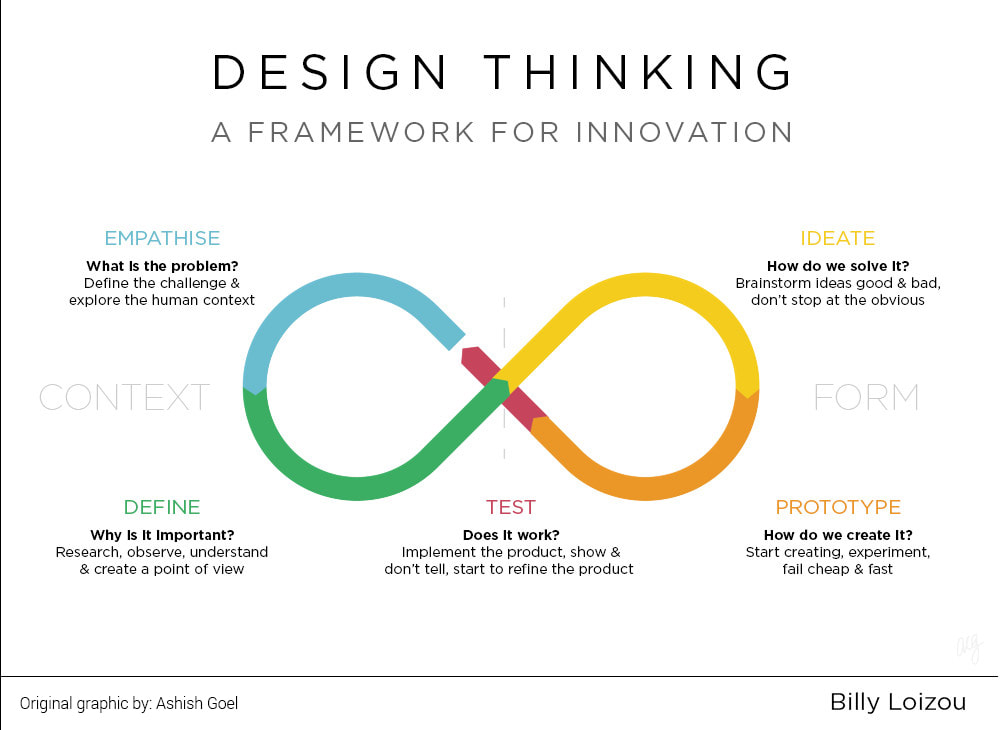 Design Thinking Six Basic Stages:
Design Thinking will help 'invent a future' however the process of testing your idea, refining your product and then bringing it to life with a scalable business model is the next challenge. Good luck!  I never wanted to grow up! As a kid I remember lying face down on my bed, head in the pillow, crying hysterically thinking that one day I will have to leave school and get a job. I was 10 years old and all I wanted to do was have fun, build fortresses, sketch in notebooks, eat pizza and have sleep over parties. The thought of giving up my Ninja Turtle collection would have been harder than letting go of my parents (sorry mum & dad.) Then it all became reality...I finished university and had literally no idea what I wanted to do. All I knew was that I wanted to keep my creativity, that one piece of still being a kid. A mentor of mine once told me that the dawn of technology will make everybody around us complacent and robotic. He said "our creativity would one day be our only differentiation in business and in life!" I took those words as gospel. I had a Bachelors degree in Multimedia under my belt, was fascinated by good product design, picked up digital photography and loved interacting with any new gadget I could get my hands on to. I found I was a decent designer, had a good knack for understanding business and could pick up new emerging technologies and software quite well. I was never great at any of them but I was above average at all. That was the complicated part, I was a hybrid of 3 different industries and every role I was applying for needed some sort of specialisation. Finding a company that would give me an opportunity was near impossible. However, every position I took and every company that I have worked in to date, the one skill that I prided myself in and took with me everywhere was the ability to alwaysthink outside the box. That one simple concept "creativity is allowing yourself to make mistakes." "Only 2% of people think they are more creative now then when they were a kid!" Fast forward to today, close to 10 years later and the role I was hoping for actually exists! It's called a Chief Marketing Technologist and it's 1/3 creative, 1/3 marketer and 1/3 technologist. Who would have thought? In essence, my job is to create amazing experiences between companies and their customers all over the world by utilising marketing technology. The Art of Creativity Most of the world still thinks of creativity as a mysterious quality that only some of us have. I believe creativity can be taught and anyone can tap into their creative spirit.
“Creative people are adults |